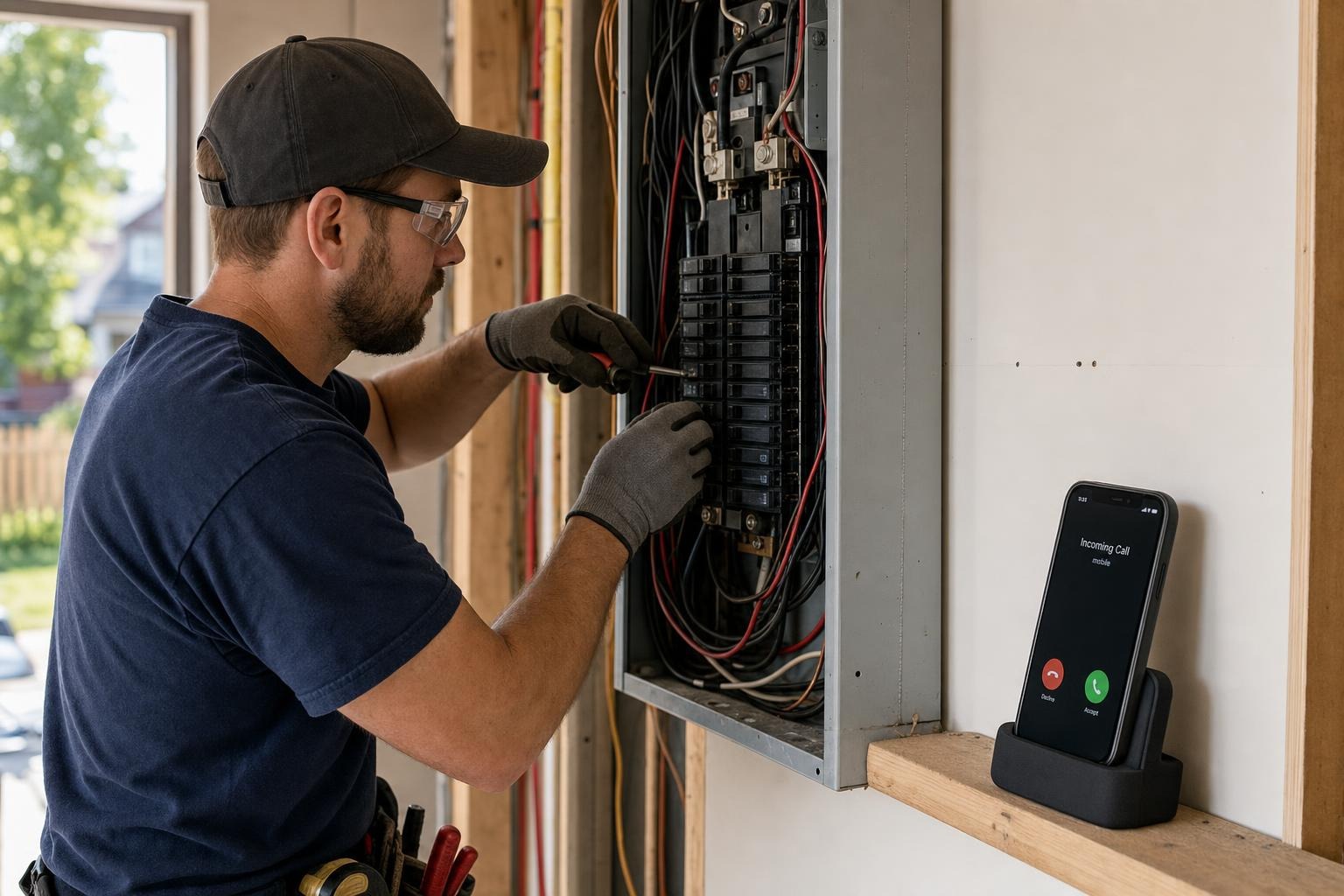
The quickest defensible estimate starts with one week of call history. Count unanswered new-customer calls, remove spam and administrative calls, identify which callers were never recovered, and multiply that number by a booking rate drawn from your own results. The answer should be a range—not a dramatic single figure.
That distinction matters for a sole proprietor. If you are under a sink in Westdale, working at a panel in Stoney Creek, or standing on a roof in Ancaster, answering immediately may be unsafe or impossible. Yet treating every unanswered ring as a lost job exaggerates the problem. Some callers are suppliers, repeat callers, wrong numbers, or customers who leave a message and book later.
A short audit separates those groups. It shows how much genuine work may be slipping away, when calls are being missed, and whether faster callbacks, schedule changes, or live call handling would make the biggest difference.
Key takeaways
- Audit at least seven consecutive days, including evenings and weekends if customers call then.
- Deduplicate repeat attempts so one persistent caller does not become three supposed opportunities.
- Calculate low, middle, and high scenarios using your own booking history rather than an unsupported industry average.
- Value the result with both revenue and capacity in mind; a possible job has no value if you could not have scheduled it.
- Fix the call periods that create the most recoverable losses instead of changing the entire operation at once.
Start with a seven-day call audit

Open your phone history and review every incoming call from the previous seven days. A full week is usually long enough to expose daily patterns while remaining manageable. If your workload changes sharply by season, repeat the exercise during a busy period before making a long-term decision.
Create one line for each unique caller and record only what you need:
- Date and time
- Answered or unanswered
- New inquiry, existing customer, supplier, spam, wrong number, or unknown
- Whether the caller left a voicemail or text
- Whether you returned the call
- Whether contact was eventually made
- Whether the inquiry booked
- General job category, if known
Do not count each attempt separately. If the same homeowner calls at 10:05, 10:08, and 10:20 about one leaking pipe, that is one opportunity. Repeated attempts can indicate urgency, but they are not three jobs.
Classify uncertain numbers as unknown rather than quietly treating them as sales leads. You can investigate them by checking voicemail, text messages, and your callback history. If there is still no evidence, keep them in a separate category and include only a portion in your high scenario.
A simple tally is enough; this does not require elaborate software. Protect any customer information you do retain, limit it to a clear business purpose, and delete it when it is no longer needed. The Office of the Privacy Commissioner of Canada’s business privacy resources provide institutional guidance for organizations handling personal information.
Pay attention to when the phone rings
The total count tells only part of the story. Group missed opportunities into practical time blocks:
- Before the first scheduled job
- During morning appointments
- Around lunch
- During afternoon appointments
- While driving between jobs
- After regular hours
- Weekends
This may reveal that the problem is concentrated. A plumber could answer reliably before 8 a.m. and after 4 p.m. but miss most calls between 9 a.m. and noon. A roofer may have the opposite pattern because weather changes the workday. The right fix depends on the actual window, not an assumption that the phone must be covered identically all day.
Calculate a defensible range, not a fantasy number
Once the audit is complete, use this calculation:
`Unanswered new inquiries × unrecovered share × expected booking rate = estimated jobs lost`
Each input has a specific meaning.
Unanswered new inquiries are calls that appear to come from potential new customers. Exclude suppliers, spam, wrong numbers, and known administrative calls.
Unrecovered share is the portion of those callers you did not reach in time to continue the conversation. If you missed eight legitimate inquiries but called back and spoke with five, three remained unrecovered.
Expected booking rate is the percentage of qualified conversations that normally become scheduled work. Use your own records where possible. If 12 of your last 20 suitable inquiries booked, your observed rate was 60%. That rate is more useful than an unattributed statistic covering different trades, cities, price points, and job types.
If you do not yet track bookings, calculate three scenarios. For example, apply 25%, 50%, and 75% booking rates. These percentages are assumptions for sensitivity testing, not claims about the trades industry. They show how the result changes under cautious, moderate, and optimistic conditions.
Suppose four legitimate callers remained unrecovered:
- At 25%, the estimate is one lost job.
- At 50%, the estimate is two lost jobs.
- At 75%, the estimate is three lost jobs.
That range is more honest than declaring that all four callers would have hired you. It is also useful for decisions: if a call-handling change makes sense even under the low scenario, the case for testing it is stronger.
Add a confidence label
Not every missed opportunity deserves equal weight. Label each as:
- Confirmed: The caller later said they hired someone else, or another clear outcome shows the work was lost.
- Probable: The caller described a relevant job but could not be reached afterward.
- Possible: The number and timing look plausible, but there is no message or other evidence.
Report confirmed cases separately. Apply the booking calculation to probable cases, then include possible cases only in the upper end of the range. This prevents unknown calls from dominating the result.
Separate recoverable calls from noise
The purpose of the audit is not to make the largest number possible. It is to identify calls that could realistically have become jobs.
Start by removing obvious noise: automated calls, sales pitches, wrong numbers, supplier updates, and internal coordination. Next, separate existing-customer service from new work. A current customer asking about an invoice may require attention, but it should not be counted as a newly lost job.
Then review callbacks. An unanswered call is not necessarily lost if you spoke with the homeowner 15 minutes later and booked the work. Record it as recovered. If you returned the call two hours later and heard that the customer had already found someone, record the outcome as confirmed lost.
Voicemail can also change the classification. A detailed message about a service you provide is stronger evidence than a silent eight-second call. At the same time, no voicemail does not prove there was no opportunity. A homeowner with water spreading across a floor may simply call the next plumber.
Exclude work you would not accept
A relevant caller is not automatically a qualified job. Remove inquiries that fall outside your service area, trade, schedule, or preferred type of work. A Hamilton electrician who does not take a particular category of project should not assign revenue to that inquiry merely because the phone rang.
Capacity matters too. If your calendar was completely full and you would have declined every additional appointment, the theoretical demand is useful operational information, but it is not immediately recoverable revenue. Keep a separate count for qualified work you could not schedule. That may point to a capacity or scheduling issue rather than a phone-answering issue.
Put a dollar value on the leakage
After estimating the number of jobs, multiply the low, middle, and high figures by an appropriate average invoice value:
`Estimated lost jobs × average invoice value = potential revenue not captured`
Use an average for the same type of work represented in the missed calls. Combining a small service visit with a large installation can produce a misleading number. If the caller’s needs are unknown, use a conservative average for your common service jobs rather than your largest invoices.
Revenue is not profit. Materials, subcontracting, fuel, travel time, payment fees, and labour all reduce what remains. A better decision model compares the expected contribution from recovered work with the cost and effort of the proposed solution.
For example, if the low estimate is one additional bookable job per month, ask three questions:
- What would that job typically invoice?
- What direct costs would come with completing it?
- Could it fit into the schedule without displacing more valuable work?
This keeps the analysis grounded. A high-value installation that cannot be staffed is not equivalent to a service call that fits between existing appointments.
Decide what to change first

Match the response to the pattern in your audit. If most losses occur during a single recurring appointment block, begin there rather than rebuilding the entire day.
Shorten the callback window. Set fixed points to review missed calls, such as after each completed job or before leaving a service area. This costs little, but it still depends on being able to stop and return calls promptly.
Use a clear voicemail message. Ask callers to leave their address, job type, urgency, and preferred callback number. This can improve the information available for triage, although it does not provide a live answer or book the work.
Adjust who handles the phone. If another person already has an appropriate role in the business, define when they can take calls and what information they should collect. Avoid informal arrangements that leave responsibility unclear.
Use live automated call handling. This is most relevant when legitimate calls arrive while your hands are occupied, you are driving, or you are working in a place where answering is impractical.
Whichever option you choose, test it against the same measures for two to four weeks: unanswered new inquiries, unrecovered callers, booked jobs, and unsuitable inquiries. A before-and-after comparison is more informative than judging the change by whether the phone feels quieter.
How an AI secretary fits the workflow
For a Hamilton sole proprietor, an AI secretary is one way to cover calls without stopping work to answer. volttus.ca is built in Hamilton for Hamilton plumbers, electricians, HVAC contractors, roofers, and general trades. It answers in under two seconds, books the job, and texts the tradesperson the address.
The practical benefit is not that every caller becomes revenue. The benefit is that more callers can receive an answer and provide booking information while the tradesperson remains on the job. Results should still be measured using the same audit: how many suitable inquiries were captured, how many appointments were booked, and how much of that work could be completed.
The published offer includes unlimited calls from $79 per month for the Founding 50. When comparing that cost with possible recovered work, use the low end of your estimate first. That avoids justifying a recurring expense with optimistic assumptions.
Coverage also needs to match the real operating area. The service is positioned for Hamilton trades from Stoney Creek to Westdale to Waterdown and works with the 905, 289, and 365 area codes. Before changing any call process, test how booking details reach you and confirm that the resulting appointments fit the way you schedule work.
A hypothetical Hamilton trades example
Consider a sole-proprietor electrician reviewing one ordinary week. This is a calculation example, not a customer result.
The call history shows 26 incoming calls. Eight were unanswered. After reviewing messages and callbacks, the electrician classifies them as follows:
- One supplier call
- One obvious sales call
- Six plausible new-customer inquiries
Two of the six homeowners were reached later, and one booked. Four callers were never reached. Those four form the unresolved pool; the recovered booking has already been captured and should not be counted as lost.
Without a reliable historical booking rate, the electrician applies three scenarios to the four unresolved inquiries:
| Scenario | Assumed booking rate | Estimated lost jobs | |---|---:|---:| | Cautious | 25% | 1 | | Middle | 50% | 2 | | High | 75% | 3 |
The call times show that three of the four unresolved inquiries arrived between 9:30 a.m. and noon while the electrician was working at a residential panel. The fourth came after hours.
That pattern suggests a focused next step: improve live coverage during the morning appointment block and decide separately whether after-hours work is desirable. After a two- to four-week test, the electrician can compare how many callers were answered, how many suitable jobs booked, and whether the calendar could absorb them.
The example does not prove that one method will produce a particular return. It demonstrates how a sole proprietor can move from a vague concern—“I miss too many calls”—to a bounded estimate and a testable operational decision.
Frequently asked questions
What counts as a missed call?
For this analysis, it is an incoming call that did not receive a live answer. It may still be recovered through a callback, voicemail, or text. Only unrecovered, qualified inquiries belong in the potential-loss calculation.
How long should I track calls?
Start with seven consecutive days. Extend the audit to four weeks if call volume is low or the first week is unusual. Seasonal trades should repeat the process during materially different periods rather than assuming one week represents the full year.
Should repeat calls from the same number be counted separately?
No. Group attempts that relate to the same need as one opportunity. Keep the number of attempts as a secondary note because it may indicate urgency, but do not multiply the estimated job count.
Should after-hours calls be included?
Include them if you would accept and schedule the work. Track them separately if you do not provide emergency or after-hours service. This distinction shows whether better answering would capture suitable work or simply document demand you would decline.
What if I have no historical booking rate?
Use clearly labelled low, middle, and high assumptions, then begin recording outcomes from answered inquiries. Replace the assumptions with your observed rate once you have enough relevant calls to make the figure useful.
How often should the estimate be updated?
Review it monthly while changing the call workflow. Once the pattern is stable, a quarterly review may be sufficient. Recheck sooner when seasonality, service areas, working hours, or available capacity change.