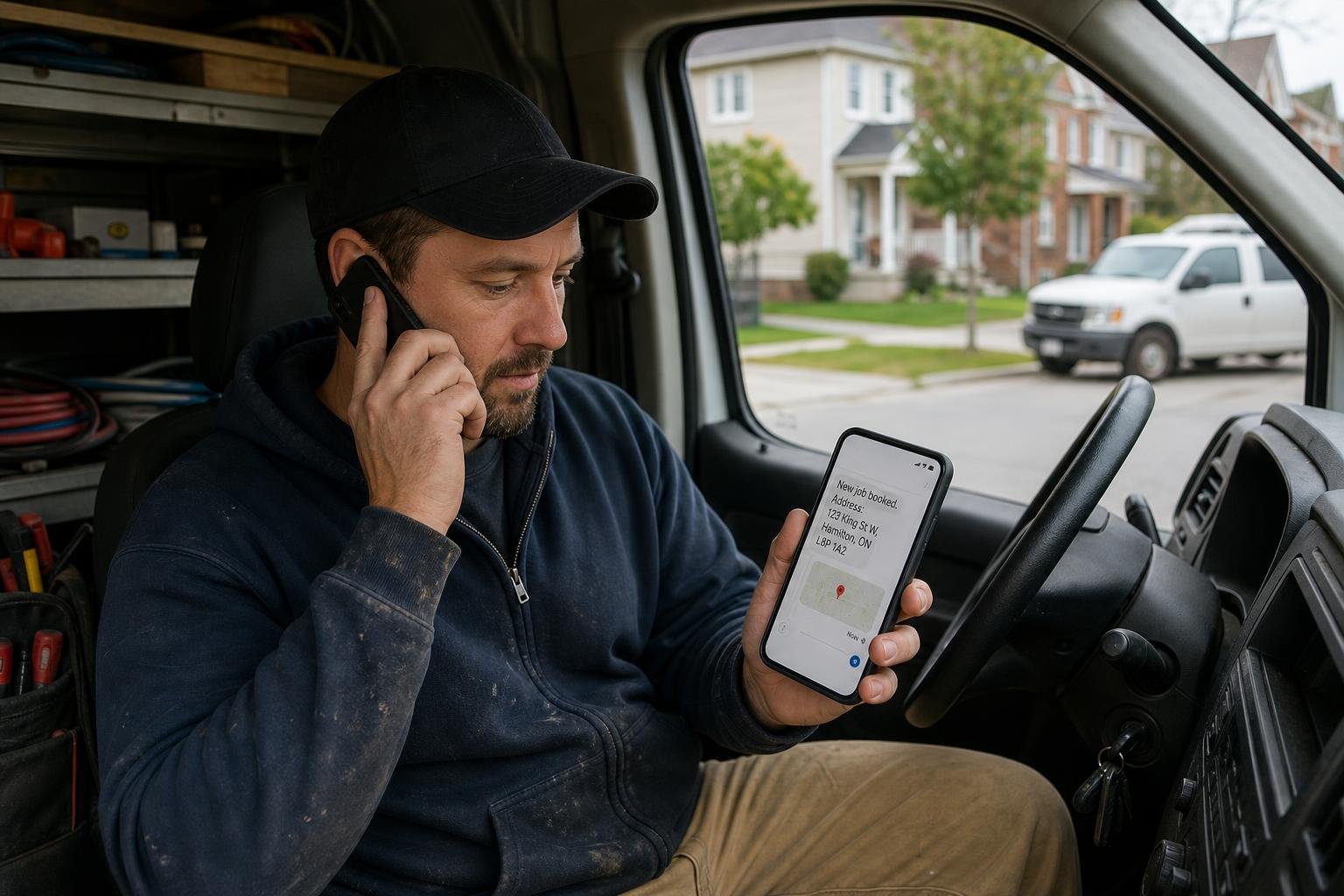
The verified workflow is straightforward: Volttus answers an incoming call in under two seconds, books the job and texts the service address to the trade professional. For a Hamilton sole proprietor working under a sink, on a roof or beside an HVAC unit, that sequence turns an unanswered ring into usable job information without requiring the contractor to stop working and reach the phone.
That concise description also defines the limits of what can responsibly be claimed. The approved information confirms fast answering, job booking and address delivery by text. It does not specify every question asked during the call, how calendar availability is configured or whether a caller receives a separate confirmation. Those details should be checked in a live test rather than assumed.
Key takeaways
- Volttus is built for Hamilton trades, including plumbers, electricians, HVAC contractors, roofers and general contractors.
- The confirmed sequence is call answering in under two seconds, job booking and delivery of the service address to the contractor by text.
- The practical benefit is continuity: an incoming customer can be answered while the owner is occupied on a job.
- A live test is available by phone for free without signup, making it possible to assess the experience directly.
- Contractors should verify booking rules, wording and information-handling practices against their own operating needs before relying on any answering system.
What the confirmed workflow does
A missed call is an operational problem for a small trade business because the owner is often both the person doing the work and the person expected to answer new customers. The phone may ring while a plumber has both hands on a fitting in Westdale, an electrician has power isolated at a panel or a roofer is working at height in Ancaster. Stopping immediately may be inconvenient or unsafe; waiting until later risks losing the opportunity.
Volttus is intended to cover that gap. Something answers rather than allowing the call to go unattended, and the interaction proceeds toward booking the job. Once booked, the service address is sent to the contractor by text.
This is more specific than a conventional message-taking promise. A message such as “someone called about a leak” still leaves the owner to return the call, establish where the customer is and arrange a time. The confirmed Volttus workflow advances the interaction to a booking and provides the address needed to identify the destination.
It is also important not to read more into that promise than the approved information supports. There is no confirmed public detail here about dispatch optimization, payment collection, estimates, emergency diagnosis, calendar integrations or customer relationship management software. The dependable description is narrower: answer promptly, book the work and text the address.
Step by step: from incoming call to address text
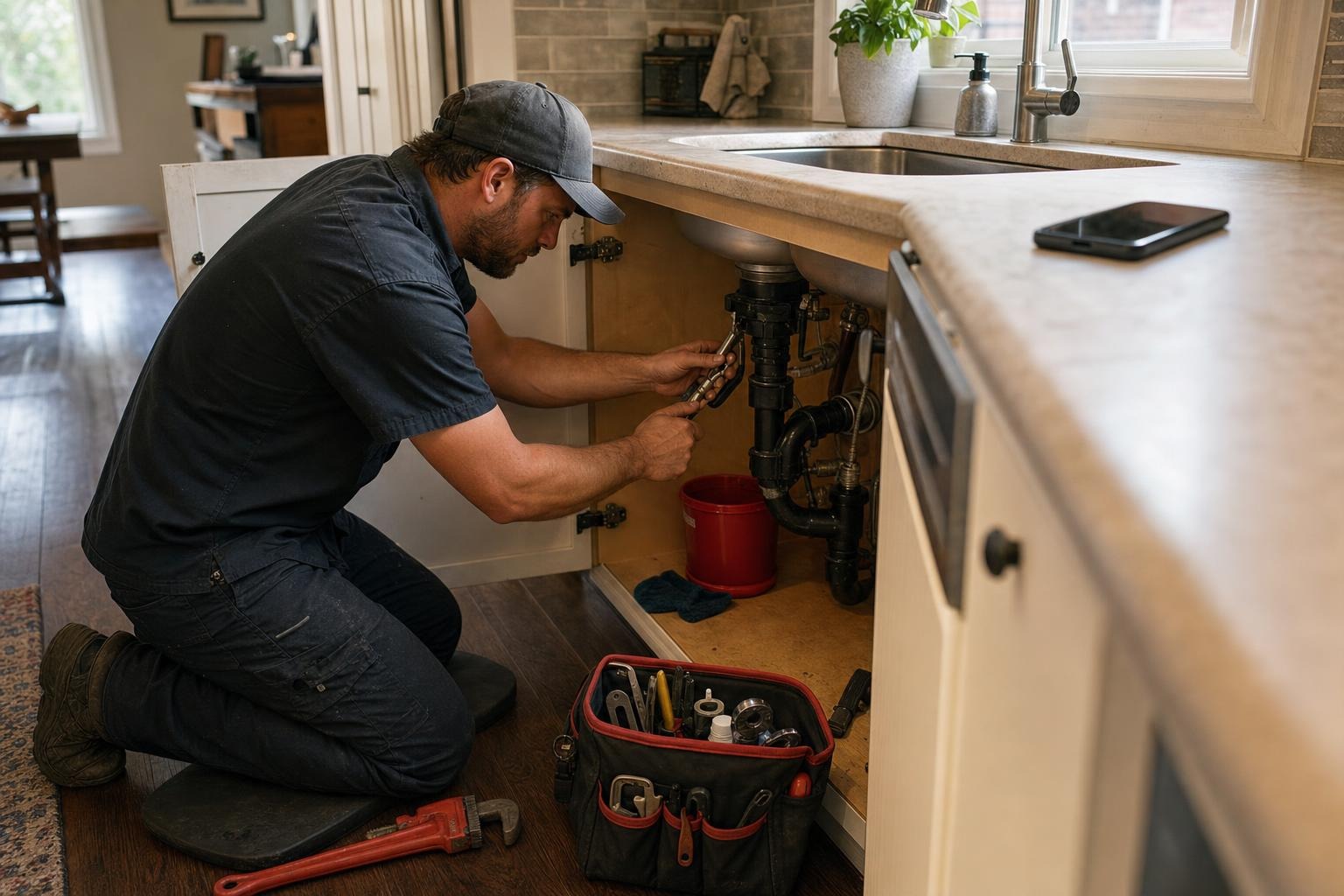
1. The customer’s call is answered
The process begins when a prospective customer calls. Volttus is described as online and able to pick up in under two seconds. That speed matters because callers do not have to wait through an extended ring sequence while the contractor decides whether it is safe to stop working.
For the business owner, this step reduces the immediate conflict between serving the customer already on site and responding to the next person seeking help. It does not require the contractor to climb down a ladder, remove gloves or reach a phone left in the truck simply to prevent the call from going unanswered.
Fast pickup is only one part of call quality, however. A contractor evaluating the service should listen for whether the interaction sounds appropriate for the type of work and local customer base. A Hamilton homeowner calling about a furnace problem may describe the situation differently from a property manager arranging a roofing visit. A realistic test is the best way to judge the experience.
2. The call proceeds to a booking
The next confirmed step is booking the job. This is the key difference between answering a call and moving it toward scheduled work. Instead of leaving the contractor with only a voicemail or callback request, the workflow is designed to produce a booking.
“Booking” can mean different things across trade businesses, so owners should define what it means in their own operation. One contractor may use fixed arrival windows. Another may schedule an initial site visit before quoting. A solo plumber may keep part of each day flexible, while a roofer may group inspections geographically and account for weather.
The approved information does not state how these individual rules are configured. Contractors should therefore test questions that affect their daily schedule: whether callers can request a preferred time, how unavailable periods are treated and how unusual jobs are handled. The purpose is not to assume a feature exists, but to determine whether the confirmed booking function fits the way the business actually accepts work.
3. The service address is sent by text
After the job is booked, Volttus texts the contractor the address. This gives the owner a concrete piece of job information in a format that can be checked when it is safe and convenient to do so.
Consider a sole-proprietor electrician finishing a call in Waterdown. A new customer phones while the electrician is occupied. Once the interaction has resulted in a booking, the service address arrives by text. The electrician can review it after completing the immediate task rather than trying to remember an address heard during a hurried conversation.
The address also helps the contractor assess the basic geography of the next commitment. Volttus is positioned for Hamilton-area trades, from Stoney Creek to Westdale and Waterdown, and works with the 905, 289 and 365 calling areas. Exact travel planning or route optimization is not part of the confirmed offering, but receiving the destination gives the contractor information needed for their own planning.
Why the workflow matters for a sole proprietor
Large service companies may have dispatchers, receptionists and office staff. A sole proprietor usually does not. Every interruption is absorbed by the same person who is diagnosing the fault, handling tools, speaking with the current customer and driving between locations.
That makes call coverage less about administrative convenience and more about protecting focused work. A plumber cannot always answer safely while carrying equipment down stairs. An HVAC contractor may be taking measurements in a noisy mechanical room. A roofer should not divert attention from footing and weather conditions to answer a ringing phone.
The workflow also addresses the lag that follows a missed call. Returning a voicemail is not the same as reaching the caller. The person may already have contacted another contractor, be at work or be unable to answer. When the initial call is answered and moved to a booking, the contractor does not begin with another round of phone tag.
There is still a role for the owner’s judgment. A booked address does not by itself reveal the full scope, required materials, travel time or suitability of a job. The text should be treated as a practical handoff, not a substitute for professional assessment. The contractor remains responsible for deciding how to prepare and perform the work.
What to verify in a live test

Volttus can be phoned live for free without signup through its official website. A useful test should resemble the calls the business actually receives rather than a generic conversation.
Start with one ordinary scenario. A plumber might describe a leaking kitchen pipe, while an electrician could request a visit for a non-working outlet. Use a realistic Hamilton-area location and pay attention to the sequence from pickup through booking. Do not provide a real customer’s personal information during an evaluation.
Then test an unclear scenario. Callers often describe symptoms rather than jobs: “the furnace makes a strange noise” or “water is showing on the ceiling.” Observe how the interaction handles limited information without assuming that it offers diagnosis or emergency triage.
Finally, assess the output from the contractor’s perspective. Confirm that the address text is understandable and arrives in a useful form. The approved description guarantees the address component, but businesses may need other details to prepare for work. Identify any gap between what is confirmed and what your operation requires.
A short evaluation checklist includes:
- How quickly was the test call answered?
- Did the interaction reach a clear booking outcome?
- Did the contractor receive the service address by text?
- Was the wording suitable for the type of trade?
- Did any question arise that requires clarification before adopting the workflow?
Testing should be repeated with a few representative situations. One smooth call cannot demonstrate how every customer request will be handled, just as one unusual call should not be treated as the entire experience.
Operational trade-offs to consider
An automated answering and booking workflow can preserve the owner’s attention, but standardization introduces trade-offs. The value depends on how closely the booking process matches the business.
The first issue is scheduling control. A contractor with predictable appointment blocks may find booking straightforward. Someone whose day changes with emergency repairs, weather or supplier availability may require more flexibility. Because the approved material does not describe specific scheduling controls, this is a point to verify rather than infer.
The second issue is job qualification. Booking a visit does not necessarily establish that a job is within the contractor’s licence, service area, pricing model or technical scope. Each business needs a process for reviewing a booking and deciding whether follow-up is required.
The third issue is customer expectation. The contractor should know what commitment the caller believes has been made. Does the booking represent an exact appointment, an arrival window or an initial request? Public brand information confirms that the job is booked but does not provide the wording used to define that commitment. Listen for it during the live test.
Cost also belongs in the decision. The approved offer states unlimited calls from CAD $79 per month for the Founding 50. “From” pricing and limited availability make it important to confirm the current terms directly before budgeting. The relevant comparison is not merely the monthly amount; it is whether the workflow suits the volume and kinds of calls the business receives.
Handling customer information responsibly
A service address can be personal information when it is connected to an identifiable customer. Contractors should therefore consider how booking information is viewed, used, retained and protected within their own business.
The Office of the Privacy Commissioner of Canada explains the principles businesses should consider under the Personal Information Protection and Electronic Documents Act. These include identifying purposes, limiting collection, using appropriate safeguards and providing accountability.
This institutional guidance is not evidence of any specific Volttus compliance feature. It is a framework for the contractor’s evaluation. Practical questions include who can access the phone receiving address texts, whether message previews are visible on a locked screen, how long job information is retained and what happens when a customer requests access or correction.
A sole proprietor may use one phone for both personal and business communication, which makes these questions easy to overlook. Simple operating discipline matters: secure the device, avoid forwarding customer details unnecessarily and remove information according to an appropriate retention practice. Businesses with legal or regulatory questions should obtain advice suited to their circumstances.
A practical evaluation process
Begin by writing down how a new job currently moves from ring to calendar. Note where calls are missed, how often callbacks are delayed and which details are essential before attending a site. This produces a real standard against which to judge the service.
Next, phone the live experience without signing up. Run several realistic scenarios covering ordinary work, an unclear request and a call from outside the preferred area. Focus on confirmed outcomes: prompt answering, a booking and the address text.
Afterward, compare the result with the business’s requirements. Separate essential needs from preferences. Receiving the correct destination may be essential; having information arranged in a particular personal shorthand may simply be convenient.
Finally, decide what still requires confirmation. Pricing, availability under the Founding 50 offer and any workflow details not published in the approved material should be verified directly. This approach keeps the decision grounded in observable behaviour instead of assumptions about what an AI secretary might do.
Frequently asked questions
Who is Volttus built for?
It is built in Hamilton for Hamilton trades. The approved audience includes sole-proprietor plumbers, electricians, HVAC contractors, roofers and general contractors, with locations named from Stoney Creek to Westdale and Waterdown.
How quickly does it answer?
The published business information states that calls are answered in under two seconds. Contractors can evaluate the live experience by phoning it free without signup.
Does it only take a message?
No. The confirmed offering goes beyond message taking: it answers, books the job and sends the service address to the contractor by text.
What information is included in the text?
The approved information specifically confirms the address. It does not provide a complete list of other fields or message contents, so additional details should not be assumed without testing or confirmation.
Does the customer receive a text confirmation?
The available business information says the contractor is texted the address. It does not confirm a separate customer text, so this should be checked during evaluation if it is important to the business.
Can it diagnose an electrical, plumbing, HVAC or roofing problem?
Diagnosis is not part of the confirmed offering. Trade professionals should continue to assess the site, determine the scope and make technical decisions within their own qualifications and responsibilities.
How much does it cost?
The approved offer is unlimited calls from CAD $79 per month for the Founding 50. Because this is “from” pricing tied to a limited offer, current price and availability should be confirmed directly.