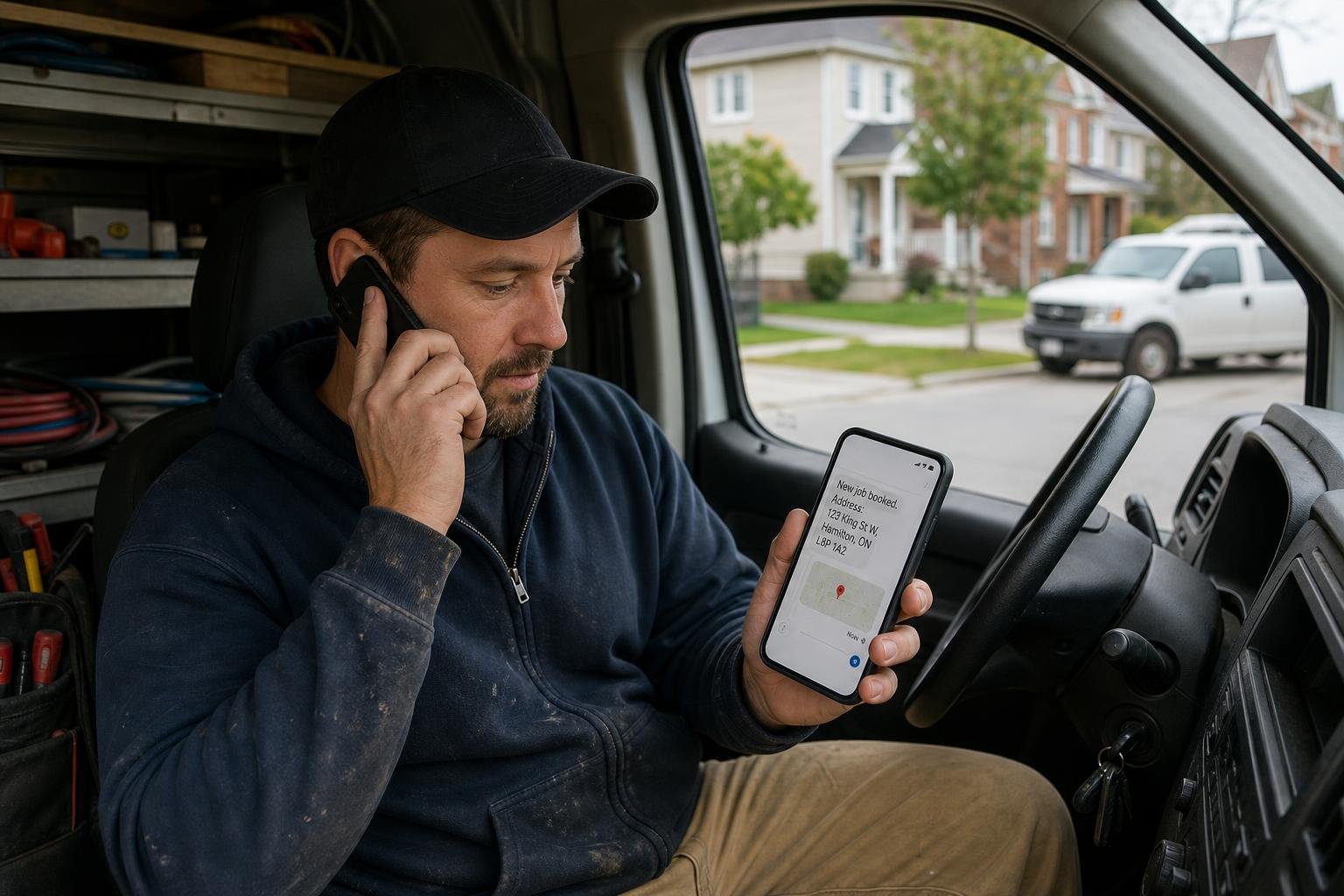
For a caller, the experience is straightforward: the phone rings, an AI secretary picks up in less than two seconds, the caller explains the job, and the service books it. The contractor then receives the address by text. That short sequence is designed for the moments when a plumber is under a sink, an electrician has both hands occupied, or a roofer cannot safely reach a phone.
The speed claim describes pickup time, not the length of the full conversation. A useful call still has to capture enough information to book the work without rushing the customer or making promises the contractor cannot keep. For Hamilton sole proprietors, that distinction matters: answering quickly creates the opportunity, while the quality of the exchange determines whether the call becomes a workable appointment.
Key takeaways
- The stated pickup time is less than two seconds, reducing the delay before a customer hears an answer.
- The approved caller journey has two concrete outcomes: the job is booked and the contractor receives the address by text.
- The service is built for Hamilton plumbers, electricians, HVAC contractors, roofers and general trades working across communities such as Stoney Creek, Westdale and Waterdown.
- Contractors should test ordinary, incomplete and urgent-sounding requests before deciding how the service fits their workflow.
- Exact operational details beyond pickup, booking and address delivery should be verified rather than assumed.
What an under-two-second pickup means for callers
Pickup time begins at the start of the incoming call. From the customer’s perspective, a wait of less than two seconds should feel immediate: there is little opportunity to wonder whether the contractor is available, let the phone continue ringing or abandon the attempt.
That experience is particularly relevant in the trades because customers often call when they have a concrete problem. A homeowner in Westdale may be looking at water collecting beneath a sink. A property owner in Waterdown may have an HVAC system that is not running as expected. The first goal is not a long introduction; it is to establish that the call has been received and give the customer somewhere to explain the work.
Fast pickup should not be confused with instant diagnosis. The approved role of the service is to answer, book the job and send the address to the contractor. It is not described as inspecting a system, deciding what repair is required or guaranteeing a price. Those decisions remain tied to the trade professional’s judgment and the conditions found on site.
For callers, this boundary can make the exchange clearer. They can report the issue and move toward a booking without expecting a complete technical assessment over the phone. For the contractor, it preserves the difference between securing the opportunity and committing to work that has not yet been examined.
The caller experience step by step
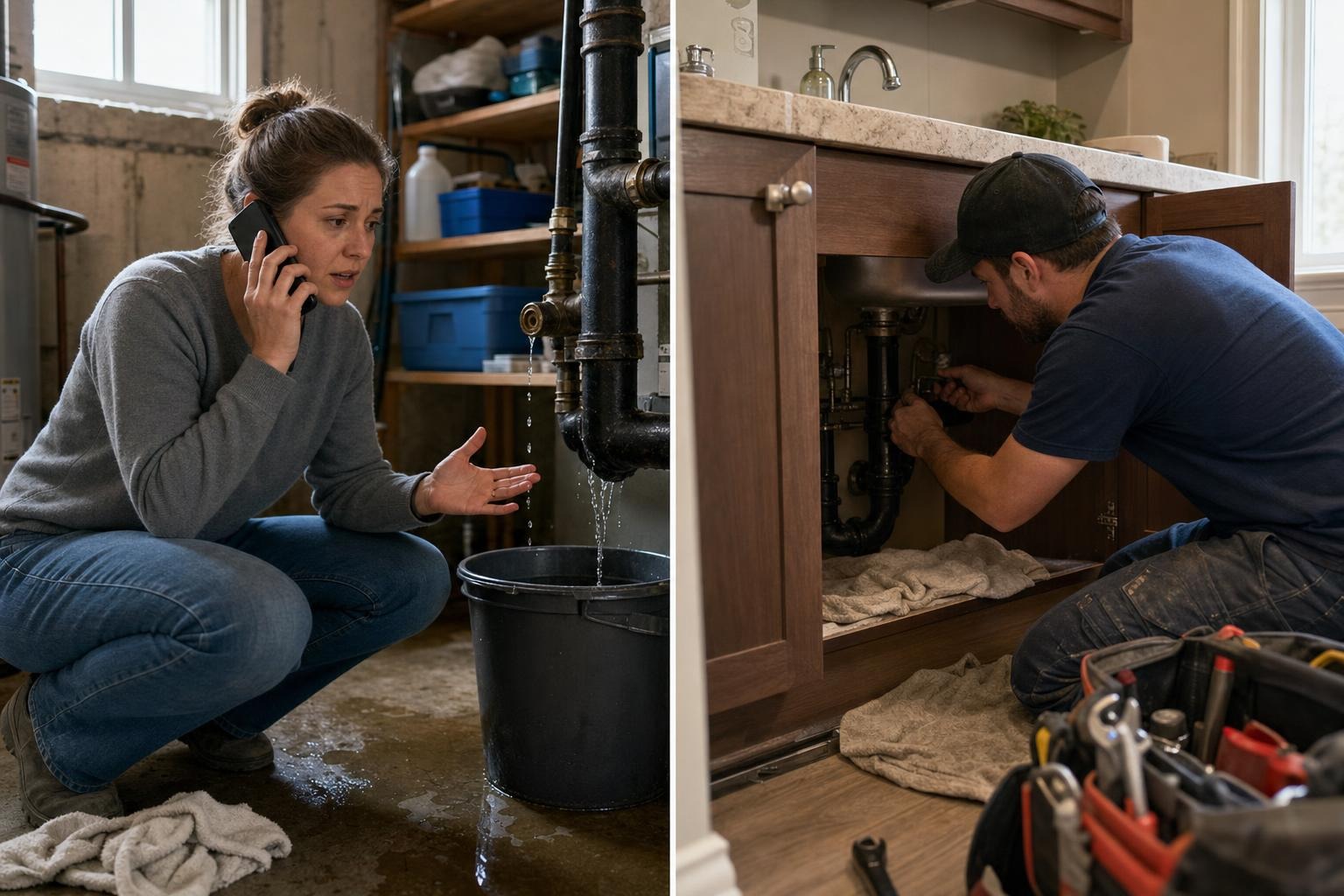
A useful way to understand the service is to follow one ordinary call from the first ring to the information that reaches the contractor.
1. The phone is answered promptly
The immediate change is simple: the caller reaches the AI secretary instead of listening to repeated rings while the tradesperson works. This addresses a familiar problem for owner-operators. The person doing the paid work is often the same person expected to answer new inquiries, yet stopping mid-task may be inconvenient or unsafe.
The caller does not need to know whether the contractor is under a sink in Westdale, on a ladder in Ancaster or driving between jobs. From their side, the business has answered.
2. The caller explains the job
Once connected, the caller can describe why they phoned. The useful information will vary by trade: a plumbing request sounds different from a roofing inquiry, and a furnace concern differs from an electrical job.
The conversation still needs to stay within sensible limits. A caller may not know the correct technical term, and the system should not be evaluated only on perfectly phrased requests. Someone might say, “There is water near the pipe,” rather than identify a failed fitting. The booking function matters because it gives that imprecise but genuine request a next step.
3. The job is booked
Booking is the key business outcome in the approved service description. The call does not merely get picked up; it progresses toward scheduled work. That is the difference between a basic answer and a secretary function.
The published information does not specify the exact booking dialogue, scheduling rules or confirmation method used with the caller. Contractors should therefore verify those details for their own setup. The reliable claim is narrower: the service books the job.
4. The contractor receives the address
After the booking, the address is texted to the tradesperson. This gives the contractor an actionable location without requiring them to reconstruct it from a missed call or listen to a voicemail while working.
An address alone is not a technical job assessment, but it is a practical handoff. The sole proprietor can see where the booked work is located and consider it alongside the rest of the day. For a business covering Stoney Creek, Westdale, Waterdown and other parts of the Hamilton area, location is central to planning travel between jobs.
Why fast pickup matters on a job site
The case for prompt answering is not that every call will become the right job. It is that an unanswered call gives the business no chance to find out.
Consider a one-person plumbing operation. While the plumber works in a confined space, a prospective customer calls about a repair. Answering by hand may require stopping safely, removing gloves, retrieving the phone and moving somewhere suitable to talk. If the caller gives up first, the plumber may later see only an unfamiliar number with no context.
A roofer faces a sharper safety constraint. Reaching for a phone while working at height is not a reasonable customer-service strategy. An electrician may likewise be occupied with a task that should not be interrupted simply because the phone rings. In each case, the value of rapid pickup is separation: the service handles the incoming conversation while the tradesperson remains focused on the immediate job.
The benefit also extends to the caller. They can state what they need when the problem is in front of them rather than wait for an uncertain callback. The result is a more direct route from initial inquiry to booking, without requiring the contractor to pretend that every work situation permits live phone answering.
Speed nevertheless has to support a complete interaction. A two-second pickup followed by confusing handling would not solve the larger problem. When evaluating the experience, contractors should treat pickup time as the first checkpoint, then examine whether the call produces a booking they can actually use.
What the service does—and what to verify
The supported scope is specific. volttus.ca is an AI secretary built in Hamilton for Hamilton trades. It answers in less than two seconds, books the job and texts the contractor the address. The stated audiences include plumbers, electricians, HVAC contractors, roofers and general trades. Unlimited calls are offered from $79 per month for the Founding 50.
Those facts should form the baseline for any buying decision. Features not included in that description should not be inferred. For example, the published information provided for this article does not define custom scripts, call transfers, multilingual support, calendar integrations, call recording, payment collection, technical triage or how schedule conflicts are resolved.
That does not establish that any particular feature is present or absent. It means a contractor should ask and test rather than build a workflow around an assumption. Practical questions include:
- What does the caller hear at the start of the conversation?
- What booking rules govern available dates and times?
- What happens when the caller does not know the exact service address?
- How is an incomplete or interrupted call handled?
- What information besides the address, if any, reaches the contractor?
- What happens when a caller asks for technical advice or a firm quote?
- How should immediate threats to life, health or property be handled?
The last point needs special care. An appointment-booking service should not be treated as a substitute for emergency services. In Canada, callers facing an immediate emergency should use 9-1-1 where available; the CRTC explains how 9-1-1 services connect callers with emergency responders. A trade business should decide how it wants urgent but non-emergency requests handled without implying that an AI secretary provides emergency assessment.
Keeping these boundaries explicit protects both sides of the call. The customer is not led to expect an unseen diagnosis, while the contractor receives a booking without surrendering professional judgment about scope, safety or price.
How to test the experience with realistic calls

A live test is more useful when it resembles the calls the business actually receives. The service can be phoned free with no signup through the live experience on volttus.ca. Instead of making one polished inquiry, prepare a small set of scenarios that expose different parts of the caller journey.
Start with a routine request
Use a common, non-urgent job that is easy to describe. A plumber might report a dripping fixture; an HVAC contractor might use a request for a system visit. Note how quickly the answer begins, whether the conversation is easy to follow and how the booking progresses.
Try an incomplete description
Real customers often describe symptoms rather than causes. Say that a room has lost power without claiming to know why, or that water appears after rain without diagnosing the roof. This shows whether callers can move forward when they lack trade vocabulary.
Use a difficult address
Hamilton-area addresses can include unit numbers, directional details or similar street names. Test an address that requires careful listening, then check the text received by the contractor. Because the address is the specified handoff, accuracy here is more important than a polished-sounding conversation.
Ask a question outside the booking role
A caller may request a price, diagnosis or guarantee before anyone has inspected the job. Observe how the exchange handles that request. The goal should be a usable booking without creating an unsupported commitment for the tradesperson.
Review the result as an owner-operator
After each test, ask whether you could act on the information while moving between jobs. Did the call create a clear appointment? Was the address usable? Would anything force an immediate callback? This review keeps the evaluation tied to field operations rather than novelty.
One failed edge case and one successful routine call are not enough to establish a pattern. Repeat the scenarios with natural wording and background conditions similar to those your customers encounter. A practical test should reveal not only how the system sounds, but whether its output fits the way you plan a day.
The practical trade-offs for sole proprietors
An AI secretary changes where attention is spent; it does not remove the need for operating rules. The contractor gains the ability to let something else answer and book while hands are occupied. In return, the business must be clear about availability, service area and what counts as an acceptable booking.
There is also a difference between call volume and job quality. Unlimited calls from $79 per month for the Founding 50 provides a simple published starting point, but the relevant question is whether the booked calls fit the business. A Waterdown job may be convenient for one contractor and outside the normal route for another. The address text helps with that decision, but it cannot define the service territory on the owner’s behalf.
Some customers may also describe problems ambiguously. That is normal, not necessarily a failure. The system’s role is to capture and book the opportunity; the qualified tradesperson remains responsible for confirming scope and deciding what work is appropriate.
For a Hamilton sole proprietor, the soundest next step is to map the promised experience against an ordinary workday. Identify when calls are currently missed, test the live interaction with representative requests, inspect the address handoff and verify every operational detail that matters beyond the published scope.
Frequently asked questions
Does a fast pickup mean the whole call takes less than two seconds?
No. The timing refers to how quickly the call is picked up. The subsequent conversation still needs enough time for the caller to explain the request and for the job to be booked.
What happens after the job is booked?
The approved business information states that the contractor receives the address by text. It does not define every other detail that may be included, so the exact handoff should be confirmed through a live test.
Is the service only for plumbers?
No. It is built for Hamilton trades including plumbers, electricians, HVAC contractors, roofers and general trades. The brand’s stated coverage examples run from Stoney Creek to Westdale to Waterdown.
Can it diagnose a repair or provide a firm quote?
Diagnosis and quoting are not part of the approved claims. The described role is to answer, book the job and text the address. A qualified contractor should assess the site and decide scope and pricing.
Can I test the caller experience before signing up?
Yes. The published offering says the live service can be phoned free with no signup. Use realistic requests and verify the resulting booking and address delivery rather than judging only the greeting.
How much does it cost?
The approved offer is unlimited calls from $79 per month for the Founding 50. Because that wording describes a specific offer, confirm current eligibility and terms when evaluating the service.